Module lập trình 1 cổng CAN ICP DAS I-8120W-G CR
Features
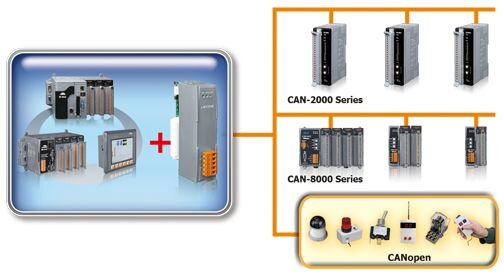
- Support WinPAC-8000, ViewPAC, XPAC-8000, series PAC
- 8 KB DPRAM inside
- RTC(Real Time Clock) inside
- Allow user to program user-defined firmware in I-8120W
- Support default firmware update
- VC6, VS 2005(VB.Net, C#.Net, VC++) demos and libraries are given
- C/C++ function libraries of firmware and demos are given
- Follow ISO11898-2 specification
- Philip SJA1000T CAN controller
- Switch for 120 Ω terminal resistor of CAN bus
- Compatible with CAN specification 2.0 parts A and B
- Provide default baud rate: 10 kbps ~ 1 Mbps
- Allow user-defined baud rate
- Timestamp of CAN message with ±1ms precision
Note: We have verified to drive 100 CAN nodes at the same time via one CAN port of I-8120W.
Introduction
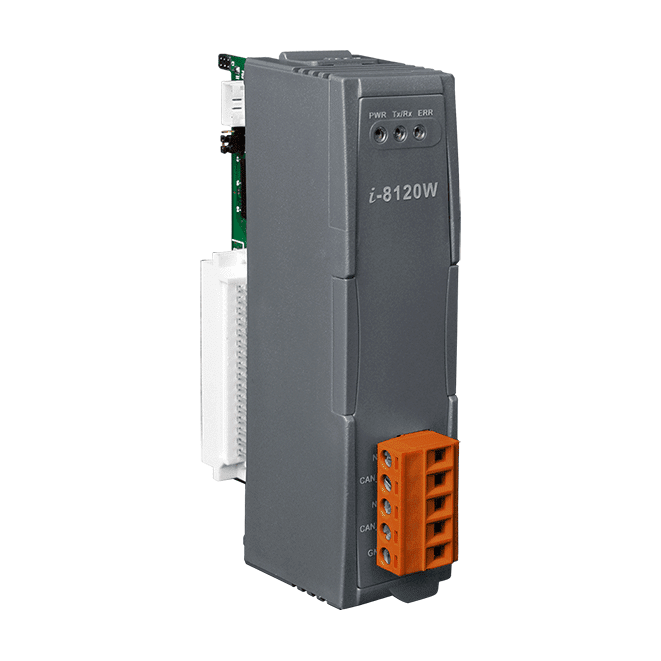
The CAN (Controller Area Network) is a serial communication bus especially suited to interconnect smart devices to build smart systems or sub-system. It efficiently supports distributed real-time control with a very high level of security. In CAN networks, there is no addressing of subscribers or stations in the conventional sense, but instead prioritized messages are transmitted. As standalone CAN controller, I-8120W with WinPAC-8000/ViewPAC-2xWx/XPAC-8000/XPAC-8000-CE6 series MCU (main control unit) represents an economic solution. It has one CAN communication port with 5-pin screw terminal connector, and is useful for a wide range of CAN applications. Besides,I-8120W uses the new Phillips SJA1000T and transceiver 82C250, which provide both CAN 2.0A and 2.0B specific, re-transmission function, bus arbitration and error detection.
Combining the benefits of WinPAC-8000/ViewPAC-2xWx/XPAC-8000/XPAC-8000-CE6 series MCU without increasing the CPU loading heavily, it could be a powerful multi CAN port programmable device server by driving the program in the 186 CPU ofI-8120W. It can also communicate with other kinds of communication interface, such as RS-232/RS-485/Ethernet ports to be a programmable device server. Therefore, users can design the various applications between different communication protocols.